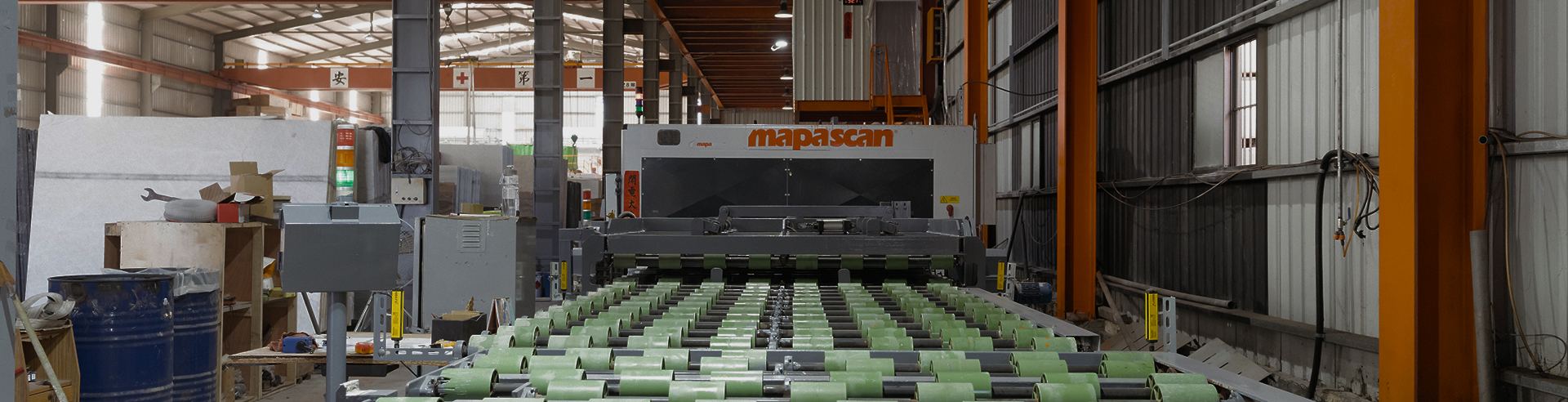
Primary granite processing in Meilun, Hualien
New Ou Shenq Enterprise Co., Ltd. was founded in 1966, and its site in the Meilun Industrial Zone, Hualien, holds two plants: one for marble and one for granite. Granite here goes through primary processing: blocks arrive, are trimmed and squared, sawn into slabs, filled and reinforced, then ground and polished, one step after another on the same site, until they leave as finished granite slabs.
Granite has a dense, tightly bound grain and resists sawing. Where the cut is set and how flat the sawn face comes out carries through to how much has to be ground off later, whether the gloss reads evenly, and whether slabs from one batch still match in tone. Because sawing and polishing sit on the same site, a colour difference or a flaw in the face can be picked up and corrected straight away, without messages travelling between separate factories, and with fewer dimensional errors introduced at each handover.
Once stone reaches the site it is difficult to swap out, so asking about material sourcing, processing capability and reserve slabs while you are still choosing a granite factory is easier than putting it right afterwards. New Ou Shenq works with contractors, architects and interior design teams, stone fabricators and overseas buyers. Company background is on About Us; marble is handled by the marble plant on the same site.
- 1966Year founded
- 26Granite varieties listed
- 5Origins for granite blocks
- 2Plants on site (marble, granite)
Four steps in the plant: from block to finished slab
A block passes through roughly four steps in the plant before it can leave as a finished granite slab, and each of them leaves its mark on the face of the slab. The machines themselves are shown on Machinery and Equipment.
-
Block trimming: squaring the raw block
Blocks do not go straight onto the saw. Weathered outer material and skewed corners are trimmed away first, so the block has a flat reference face that beds down firmly and can be set square and positioned accurately for sawing. Done properly, this is what keeps slabs from coming off the saw thick on one side and thin on the other.
-
Wire sawing: where slab quality starts
The granite plant cuts blocks on a wire saw, drawing the wire through the block to produce slabs or strips. Before cutting, the shape of the block, the direction of the veining and the position of any fissures decide how it is divided. The flatter the sawn face, the less material has to be ground away afterwards, and the more consistent the thickness across the batch.
-
Resin filling: closing natural fissures
Natural granite carries fine fissures and pinholes. After sawing, these are filled with resin, and mesh is bonded to the back where reinforcement is needed. Treated slabs are less prone to chipping during lifting, delivery to site and later cutting, and the face reads as more continuous.
-
Polishing: a polished or honed surface
On the polishing line, heads pass across the whole slab from coarse to fine grits, first taking out variation in thickness and any bow, then finishing the surface as polished or honed according to use. Slabs from one batch that run through the same sequence reflect light consistently once they are laid on the same wall or floor.
Where the slabs go, and surface finishes
Granite is hard and absorbs little water, so slabs from the plant tend to be used where traffic and weather are constant: dry-fixed and mortar-set facade cladding, lobby and arcade floors, stair treads, door surrounds, and paving for landscape and public works. On a facade, the fixing method and the way joints drain affect how slabs are divided and processed, so set out the installation method when you enquire and we can judge how the blocks should be cut.
On finishes, what the plant confirms it can supply is polished and honed. A polished face shows colour clearly and carries an obvious gloss, which suits interior feature walls and lobby floors; a honed face reflects less light and feels rougher underfoot, which suits exterior areas and busier floors. Flamed, sandblasted, bush-hammered and antiqued finishes can be arranged to suit a project. The same variety looks quite different polished and honed, so decide that while the material is being chosen, and settle cleaning and maintenance for exterior areas at the same time.
Granite varieties, grouped by origin
The granite plant currently lists more than twenty varieties, with blocks drawn from five origins. Each origin leans towards its own colour range, so a shortlist can be narrowed by application and colour before anything else:
- India - largely greys, blues and blacks
- Brazil - mainly warm tones, with greens and greys as well
- Africa - dark tones
- Middle East and Spain - white and light speckled granites
Between batches of the same variety, tone and grain coarseness can differ, so for areas that take a large quantity it is worth viewing actual slabs first and setting aside reserve slabs (attic stock) in proportion to the total.
Supply and how a project usually runs
Work usually starts with three pieces of information: where the stone is going (facade, flooring or interior), roughly how much of it, and either the variety already settled on or the colour range you have in mind. We narrow the listed varieties down to workable options and come back on availability. Once the variety is fixed, we arrange slab viewing and selection, then schedule sawing and processing against the drawings and site dimensions, with dispatch split to follow the installation sequence.
On large areas, put the selection work at the front. Differences in tone and grain between batches are hard to avoid, so reserving the whole quantity at the outset and sorting and numbering slabs by veining and lightness keeps phased deliveries from arriving visibly different; on projects built in stages, set the reserve slabs aside from the start.
Fabricators who need slabs only and carry out the later work themselves are welcome to enquire on slabs alone. Overseas buyers, please include the destination and your packing requirements; slab layout and sorting before shipment are handled to suit. Conditions across the site are set out on Why Choose Us, and once your requirement is clear you can send an enquiry.
View the slabs at the plant, or start with an enquiry
How the grain sits and how deep the background tone runs are difficult to read from a photograph; it comes down to the slab in front of you. The plant is in the Meilun Industrial Zone, Hualien (No. 62, Meigong Rd., Hualien City), and slab viewing can be arranged Monday to Friday, 08:00-17:00. Tell us the application and the quantity before you visit and we will have slabs in the relevant varieties pulled out ready.