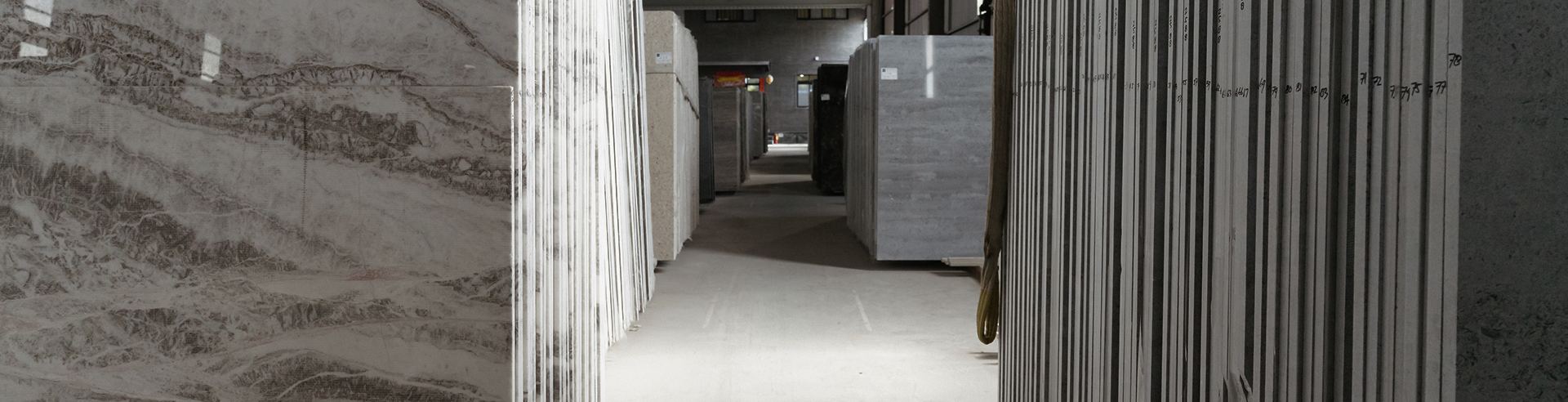
Four things to check before you pick a marble factory
Send the same drawings out to several suppliers and the quotes rarely line up. The gap usually has less to do with unit price than with how much of the work each supplier does itself, and whether you get to see the slab before anything is cut.
Before comparing numbers, ask four questions. One: which varieties are on hand, and what condition the slabs are in. A new batch of blocks shifts the colour of the same variety, so a supplier who can describe the slabs actually on the racks gives you more room when a wall is laid out. Two: is all the fabrication done in one plant. When sawing, reinforcement and polishing are split between different workshops, responsibility for sizes and colour matching is split with them. Three: how far does the machinery reach. Our machinery and equipment page shows whether the line runs from block to finished slab without a gap. Four: can you come and choose slabs. Photographs and colour cards cannot show which way the veining runs or how deep the background tone sits; on large surfaces, picking the slabs yourself is what settles the result.
New Ou Shenq Enterprise Co., Ltd. was founded in 1966, and its site in the Meilun Industrial Zone, Hualien holds two plants, one for marble and one for granite. Marble can be taken from block intake through sawing and reinforcement to polishing on site. Which steps a slab goes through, and who carries out each one, is something a visit makes plain. For the company background, see about New Ou Shenq.
- 1966Founded
- 31Marble varieties available
- 6Countries of origin listed
- 2Plants: marble and granite
Four stages in the plant: from block to a slab you can choose
A marble slab passes four stages in the plant: the block is trimmed, then sawn, then filled and reinforced, and only after that does it reach the polishing line. Whatever tolerance one stage leaves behind is magnified or absorbed by the next, so the early stages are better done slowly. The machines behind each stage are listed on the equipment page.
-
Block trimming: squaring the raw block
Blocks arrive with edges that are rarely square and surfaces that still carry the marks of long exposure. Those come off first, and the block is worked into a shape that clamps and positions cleanly, so the saw has a reliable reference to work from. Rush this stage and every later cut inherits the error.
-
Wire sawing: reading the veining before the first cut
The marble plant uses wire saws to open blocks into slabs. Before cutting, the direction of the veining is read, and that decides the cutting direction and the order the slabs come off. Whether one block yields a matching set, and whether two neighbouring slabs can be vein-matched, is settled here. Tell us at selection stage which areas need matched veining.
-
Filling and reinforcement: closing fissures and voids
Natural stone carries fine fissures and voids of its own. Once the slabs are open, resin is poured in to fill them, and mesh is bonded to the back where that is needed, so slabs behave better during lifting, turning and installation. Fill them properly and polishing will not keep enlarging the flaws.
-
Polishing: from coarse heads down to fine
The slab face runs through progressively finer heads, first to true up flatness, then down to the gloss required, finishing either polished or honed. Slabs from one batch have to run to the same settings, or colour and gloss will not read as a set. Finished slabs are then sorted and racked by background tone and veining, which is what later selection and matching works from.
Slab sizes and finishes: settle these before asking for a quote
Natural marble slabs are not a stock-size product. How wide and how long they can be opened depends on the size of the blocks that come in and how they are cut, and the same variety can differ from one batch of raw material to the next. Rather than quoting fixed sizes, we match the slabs currently on the racks against the quantities on your drawings. Tell us where the stone goes, the area involved and whether any of it needs matched veining, and we can judge whether there is enough material or whether slabs should be set aside.
The finishes produced in the plant are polished and honed. Lift lobbies, interior feature walls and accent walls, where veining and gloss are meant to be seen, usually take a polished face; where reflection has to be held down, or a floor has to stay slip resistant, a honed face is used instead. Flamed, sandblasted, bush-hammered and antiqued finishes can be arranged according to project requirements; state any edge grinding, chamfers and cut-outs at the same time.
Colour and vein variation is in the nature of natural stone, and it does not behave like the even surface of a manufactured material. External walls and outdoor steps that take sun and rain for years are generally done in granite instead; for those, see the granite varieties.
Close to thirty marble varieties: narrow by colour family first
The marble category currently holds close to thirty varieties, with recorded origins in Italy, Egypt, Turkey, Brazil, Vietnam and India. Sorting by colour family first makes selection much quicker. For a bright base, start with the pale whites; for a neutral background, several of the greys are stocked in more than one tone, shown together on a single page so a lighter and a darker step of the same family can be compared side by side; for warmer rooms, look at the beiges; and for a feature wall that needs visual weight, at the blacks. A catalogue shows the colour family but not the difference between batches, so shortlist online and then settle it at the plant against real slabs. The full list sits on the marble slabs page.
Who we work with, and how a project runs
We usually work with architectural practices, contractors, interior design firms and secondary fabricators, and we also supply overseas buyers. Some order in bulk, others just a few slabs with specified veining. Whatever the size, the sequence is much the same:
- Tell us the requirement: use, location, approximate area and drawings, plus any variety already specified or reference photographs.
- First shortlist: we come back with the varieties currently available and the condition of the slabs, judged against the location and the finish you need.
- Selection at the plant: compare veining and background tone slab by slab in Hualien, and number the sequence for any area that needs matched veining.
- Fabrication scheduling: once drawings and site-measured sizes are confirmed, cutting, edging and surface work are scheduled.
- Numbered dispatch: slabs leave numbered in laying order and are installed in that order on site, which is what keeps the veining continuous.
On projects with large quantities or several varieties combined, reserved slabs are worth discussing as early as possible, and material can also be set aside by delivery batch. Once the requirement is settled, attach the drawings and quantities to an online enquiry and send it through.
Come and choose slabs, or tell us what you need online
Veining and background tone are decided, in the end, in front of the slab itself. The site is in the Meilun Industrial Zone, Hualien, open Monday to Friday, 08:00–17:00; if you are coming to choose slabs, call or email first to arrange a time. If Hualien is out of reach, mark your candidates in the natural stone catalogue, send the drawings and quantities with them, and we will reply with the condition of the slabs and what can be done with them.